Showing posts with label horticulture. Show all posts

Friday, April 5, 2019

Come Play in My Yard


When I was in school, we learned the proper way to describe the tools and components of the horticulture trade. For example, "dirt" is something you clean up with a vacuum or wipe off your shoes; "soil" is the medium for growing healthy plants. When you talk about putting plants in dirt, it connotes the wrong idea, and that isn't immediately obvious if you haven't thought about it. Soil is more appropriate because it better signifies the rich ecosystem of minerals and organisms and fungi and decaying matter and water and air that provide the ideal medium for plant growth.

Another example that sticks out is "whacking," be it weed whacking, or whacking limbs off a tree. Just like talking about dirt, it doesn't sound professional. A word like "whack" implies sloppiness and unskilled labor, that someone isn't taking the work seriously or doesn't care about the health of those plants. When you have professional training in landscaping, or even just in general, it's simply more accurate to refer to these terms by their proper names -- a line/string trimmer, or pruning a limb from a tree.

The above instances are good things to keep in mind, and my point is not to get overly pedantic about semantics. Being a little more precise with our language is always a good goal, especially in skilled trades.

But there are phrases commonly directed at me and my colleagues that I find more frustrating than a pet peeve. "Would you like to come play in my yard?" "You can practice in my garden." "You've been playing in the dirt all day." I'm talking specifically about people who are requesting me to work on their property, or acknowledging that I've been at work all day. I know that in some cases it's said innocently, that it's just something that hasn't occurred to most people to use more precise and respectful language. That's why I'm taking a moment to write about this. If you call a plumber to fix something, you don't ask, "Hey, wanna come play with my toilet?" If your roof has a leak, you wouldn't ask the professional, "Would you like to practice on my roof?"

I want to address the inherent disrespect in that kind of language, and I want to challenge people to think differently about this kind of outdoor work. There unfortunately exists a lot of conscious and unconscious judgment against those who work in labor-intensive outdoor jobs like landscaping. People expect a lot of free or next-to-free services when it comes to the garden (or worse, food production). If people use devaluing language like "playing in my yard," they can justify paying us less, or nothing at all. For the people who've bothered to educate themselves in the field, this is insulting. This is still a job, even if I happen to enjoy it. I'm not coming over to socialize at a BBQ. Even if a person didn't have any knowledge whatsoever about horticulture, their time, their labor, and the wear and tear on their body is still worth respect, appropriate payment, and proper language. That's an important point, because landscaping work is brutal to the body. If you doubt just how hard it is, I invite you to come play in my yard.

I'm not saying that a person shouldn't ever ask for free help in the garden. I have volunteer horticulture projects that I work on, and I do help friends as I'm able to. But the casual language and attitude is something that could be improved when it comes to paying for services. I recognize that I feel even more strongly about this because my body has not been cooperative since my surgery, and the pain and other physical and psychological issues have made going back into the field full time nearly impossible. So if someone is requesting that I work for them, using cutesy phrases like "playing in the yard," I get a little annoyed. It has a demeaning impact, whether or not that was the intention. Now you know.

So unless you're inviting me over to play a game of badminton or to practice my aim at archery, please retire these disrespectful phrases, and help promote professionalism in the field.

Monday, September 21, 2015

First Completed Season at Red Barn Community Farm

As the days get shorter and the harvest peters out, I can look back at our first completed season at Red Barn Community Farm with pride, humility, and some exhaustion. Caera and I worked hard on our 40'x40' plot, building six 4'x16' beds out of cinder blocks and wood, starting a bed for the hoop house, completing an entirely enclosed 16'x16' space for our berry patch, hauling in soil (that was an adventure in and of itself), amending the soil with compost and a fertilizer blend we mixed based on Steve Solomon's recommendation from Growing Vegetables West of the Cascades, and planting lots and lots of seeds and starts. Over the summer, we also acquired a 275-gallon water tote, which we elevated for future use in a drip irrigation system. We had wanted to fence off our entire plot, as the deer were a persistent problem, but we couldn't get the materials fast enough. Nonetheless, despite our battles with deer, bugs, supply transportation, materials cost, out-of-control weeds, a summer-long drought, and a brutal wind storm, we had quite an impressive harvest.

 Let's take a look:

Jami riding the tractor. Working the soil was tough, but we had a good attitude.
After many ridiculous trips back and forth between our home and the plot with buckets full of soil stuffed into our sedans, a friend let us borrow his truck to finish the job. We hauled a lot of soil. Here we're in the process of filling up the berry patch.
Making soil angels in a half-built raised bed. Fours beds complete, and starting to fill them...
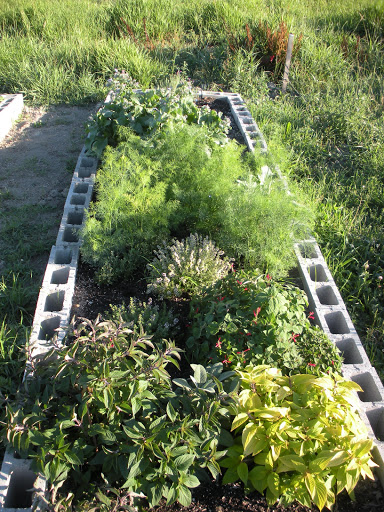
Beds are finished, and seeds and starts are in the ground. That's the berry patch in the background, and this bed with tomato starts will eventually be inside a hoop house.
Finished berry patch with chicken wire fencing, bird netting, and a simple PVC pipe gate. Why do we need so much fencing? This is why. Unfortunately we put the berry plants in the ground before the fence was finished. The deer ate the developing fruit and a lot of the branches. They don't even care about proper pruning technique!
This is my sweetie Caera. She's very happy after supporting the LWIT plant sale. This is Caera's first large-scale attempt at growing food. We're stoked to be working on it together.
The start of our flower bed. Our flower bed took off! The pollinators loved it, and we brought home so many bouquets of cut flowers.
Our kitchen alter to the Irish goddess Airmed, with flowers and food from the plot. Strawflowers have become a staple in my flower gardens. Xerochrysum bracteatum for the win!
Well-used moving boxes from last year. I think their final destination is appropriate: suppressing weeds in between our raised beds, decomposing into the earth. Gooseberries that became deer snacks.
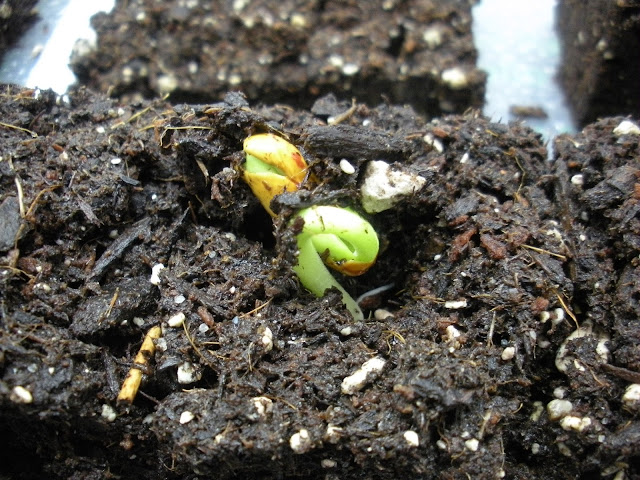
I set up two propagation stations in the laundry room. Emerging seedlings.
The house we're renting came with a greenhouse. A lot of these plants were are from last year, and were neglected a bit while I was moving all the time. To my surprise, a lot of stuff came back. A nice little pot of yarrow came back.
I thought all my perennials were goners after last year's moving chaos, but the Pagan Purples Delphinium popped up in the spring. Love the color. I grafted my first apple tree during my 2013 hort class. Since then it's sadly remained unpruned, a bit neglected, and moving around from place to place in a pot. This year it started to fruit, and I let it just for funzies.
My boss at Ironwood gave me some mystery daylilies in the spring. Score! Don't they look delicious? I mean pretty? I brought home some columbine for my sweetie. We grew it in a pot that's visible from our bedroom window.
Backyard pots. Since this isn't our own property, we aren't able to do much landscape design. Container gardening is our compromise.
Back at the plot, we upgraded our two 55-gallon rain barrels to one 275-gallon water tote elevated four feet above the ground. My intention next year is to hook up a drip irrigation system. My tomato bed turned into a hedge. Once again, this is what happens when you don't prune or stake your tomatoes.
My magic beanstalk is working. Next stop: Coin Heaven! Flower power! (Okay, I'll stop with the Super Mario Bros. references.)
Towers of quinoa. First time growing this crop. We had lots of colorful harvests.
So much food. This makes me happy. Proud mother of twins.
Tomatoes and basil. You know where this is going. I'm sorry, is my Italian showing? ;P Well-pollinated corn. This is a first for me.
Gardening is more fun with loved ones. Herb garden.

Friday, March 6, 2015

Job Openings at Ironwood

Looking for some horticultural experience? My employer is seeking out more people. My own two cents is that he's very knowledgeable, and you're sure to learn a lot about plants and the maintenance business.

Boosting the signal:


Ironwood is a small full-service landscape company and we are looking for enthusiastic people to join our team! Your horticultural training, professional landscape experience, and passion for plants is needed!

We are an organic landscape company with a strong emphasis on proper horticultural practices and great customer service. We provide high-quality garden maintenance services, landscape installation, stone walls and patios, installation of container designs, garden renovations, and fine-pruning projects.

Ironwood's owner, Derek Fowler, is a graduate of Edmonds Community College in Nursery Specialization and Landscape Design. He has traveled to China many times, built and maintained a rare plant garden on Camano Island for 10 years, is an avid hiker and native plant lover, and has a background in bio French intensive organic farming, market gardening, and community-supported agricultural systems. His goal in providing high-quality chemical-free landscape maintenance and installation services with a focus on excellent customer service, is to work with dynamic and passionate horticultural graduates and enthusiasts to contribute positively to the horticultural industry and Ironwood’s clientele. Outside of work, Derek spends a great deal of time planting common and unusual fruit and nut trees, growing and eating vegetables from his garden, and volunteering with Plant Amnesty, Washington Native Plant Society, and other groups when his family permits.

Landscape Maintenance Technicians

A good landscape maintenance technician can tell what needs attention in a landscape just by looking. With experience, the technician develops an eye to assess how the landscape was installed, why plants are not thriving, which pathogens or insects have taken hold, and what course of action may be necessary to improve or correct all of the potential problems that result from unprofessional landscape installation and management processes or approaches. When you work for Ironwood, we will teach you to stand out in a crowd of your peers as you learn to master your horticultural craft and its practice in the field. We are passionate about our work and believe in investing in our employees. We want to succeed in our business and help you succeed as part of our team.

Candidates will be enthusiastic with a positive attitude, able to work alone or with others, possess a valid WA driver’s license with a clean driving record, take direction and give direction, communicate with clients, and are punctual.

Knowledge of the following:


  • Weed identification and removal
  • Some plant identification and desire to learn more
  • Pruning- woody and herbaceous plants
  • Landscape maintenance activities- lawn mowing, line trimming, and application of organic fertilizers
  • Able to lift 50 lbs regularly
  • Pay DOE part time; full time position available
    Full time positions offer 1 week paid vacation, performance bonus options, and continued educational opportunities

    Construction Technicians

    A good construction technician is able to understand how landscapes are built and which processes are to code and how they are employed. As a technician, you are able to address soil concerns and cultivation methods, preparation of areas for lawns, walls, patios, and irrigation systems. With Ironwood, we will teach you to stand out in the landscaping industry. You will be able to see need for improvement where others see perfection, will know how to ensure that installations are made safe for all intended users, and which material is best for a given environment and its application. We are passionate about our work and believe in investing in our employees. We want to succeed in our business and help you succeed as part of our team.

    Candidates will be enthusiastic with positive attitude, able to work alone or with others, possess a valid WA driver’s license, take direction and give direction, communicate with clients, and is punctual.

    Knowledge of the following:


  • Plant identification and proper plant installation and removal techniques
  • Patio preparation and installation methods
  • Stone wall construction
  • Irrigation installation and troubleshooting – drip systems and in ground rain bird pop up systems
  • Able to lift 50 lbs regularly
  • Pay DOE part time or full time position available
    Full time positions offer 1 week paid vacation, performance bonus options, and continued educational opportunities

    Please contact Derek Fowler at ironwoodlandscapedesign (at) gmail (dot) com or Ironwood 206-229-3738.

    Friday, October 31, 2014

    Where Has the Year Gone?

    Hello, Blog! What a shame to have started a website about one of my favorite topics in the world, and then drop off the face of the earth for most of the year. If you're wondering what happened, here are the highlights:

    In March, I got hired part-time at Northwest Nurseries, Inc. (a wholesale nursery in Redmond) and The Gray Barn Nursery at Pacific Topsoils (a retail nursery in Redmond). This was in addition to my one landscape maintenance gig I do every Monday in Lake Sammamish, along with some light administrative work for the editing job. It's been a rewarding experience to work both the retail and wholesale side of the plant nursery business. I was unsure if I'd be fit for Gray Barn, given that I don't see my introverted self thriving in the retail environment, but I think it's been a good challenge for me (and it's easy to say that now, far past the height of springtime madness).

    Also in March, I had to relocate, so I ended up moving from Kirkland to Bothell. In the midst of all those transitions, I didn't have enough mental bandwidth to take the CPH exam, so I decided to hold off for a while and focus on moving, setting up my garden at the new house, and exploring my two brand-new jobs.

    Ever since I transplanted from Ohio to the Pacific Northwest, I seem to have this strange attraction to changing locations during the springtime, which unfortunately means getting a late start on the vegetable garden. This year (for the first move, that is) followed the same pattern. Nonetheless, I often came home from work and went straight to the back yard to get things set up as quickly as possible. It was a slow process that bled into summer, but I got a respectable garden going in five 4x4 raised beds, along with additional flowers and veggies growing in pots. Somehow I managed to do this while working over 40 hours a week (something my body's not used to) and being 6 months into a new and wonderful relationship with a woman in Everett. Needless to say, I was busy! Of course, Doing All The Things is not really sustainable, so I couldn't fine tune the garden the way I would have liked (and I obviously didn't carve out enough time to work on the blog), but at least I had some activity happening at home that I could be proud of.

    The garden had humble beginnings... ...and then it ate the house!

    Okay, maybe it wasn't that big. This is what happens when you don't prune your veggie plants.
    Yes, that's a pink shirt I'm wearing. Yes, I'm comfortable with this. Jami and her damned tomatoes. Always with the tomatoes.
    I had several respectable harvests. And as you all were expecting, that meant plenty of Insalata Caprese, which is my favorite summer food and perhaps the meaning of life.

    But that's not all! In July I got hired at a small landscape installation and maintenance company called Ironwood, so I reduced my hours at Gray Barn to pick up a few days with Ironwood. It's another great opportunity to get hands-on experience in the field, so I'm glad I took it on. Maintenance work is invaluable for learning how plants behave in the garden from season to season. My boss is an old pro in the horticulture field, so I'm hoping to learn a lot from him.

    In other news, finding stable housing has been a challenge this year. My partner and I decided we were ready to move in with each other by the end of summer, so we started the process of creating a household together. The details of that process are exhausting; let's just say that circumstances made it necessary for me to move three more times (and two of those moves were with my partner). Ultimately, we ended up in a house in Bothell and just finished moving last Saturday. There's a good deal of work and unpacking to do, and I'm on the mend from what I think is a minor sprained wrist, but I'm feeling really hopeful and excited about the new living arrangements. I'm sure I'll post more on that later. :)

    That's all for now. I don't think it should take another year for the next post. Cheers!